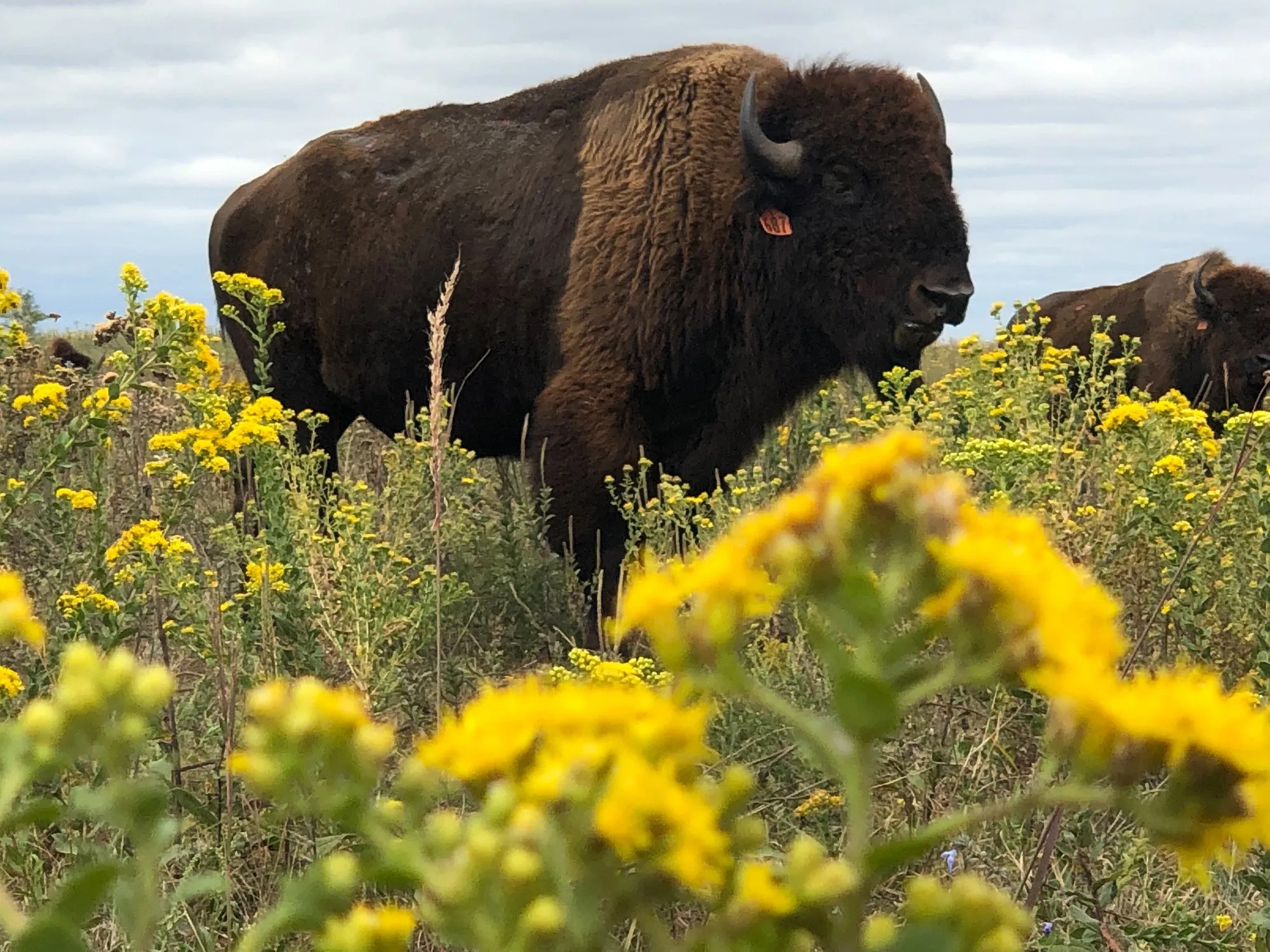
The New Mexico Bison Restoration Network is a regionally-focused rewilding project in northern New Mexico that seeks to meet the simultaneous needs of landscape-scale restoration, carbon sequestration, and community food security. The modern delineation of so many different fields and disciplines offers the benefit of depth of study, but the true interconnectedness of all things also requires that we learn again in the global north how to think and to work holistically, intuitively, and wisely. Rewilding is an interdisciplinary approach to solving the great challenges of our modern era.
Ecological restoration does not always require qualified professionals, big budgets, expensive machinery, or dramatic interventions. There are many exciting restoration projects happening in the global south which utilize the deep knowledge, the will to work, and the will to work together of local people to achieve similar landscape-scale results as are achieved in wealthy developed countries with machinery and bureaucracies and experts. Brilliant local solutions can arise to local problems, and all too often in the global north, what stands in their way is red tape, entrenched power, and resistance to innovations that disrupt the (destructive) status quo.
We are people who believe that bold actions must be taken to turn the ship of ecological degradation and its attendant cultural disintegration. We are working upstream, against the grain, to return bison to their historical range while pursuing many objectives simultaneously. For one, bison went through an extreme genetic bottleneck in the late 1800s and we must prevent this from happening again by now dramatically expanding the number of bison herds on the landscape. In addition to genetic conservation, we are working on community food security in a region where life has always existed on a knife edge. The aridification of both the soil and the climate across the west and especially in the southwest—due first to irresponsible human land use and second to climate change—is going to continually make agriculture and ranching less and less viable. Restoring keystone species—bison and beaver—and the resources upon which they depend—grasslands and riparian corridors—is the only real hope that we have for continuing to inhabit these regions. It would be dramatically less expensive too than costly and ineffective “carbon capture” technologies (a boondoggle by fossil fuel industries to capture yet more public funding), while restoring biodiversity and feeding local people. What rewilding and weening ourselves off beef asks of us is a cultural shift toward a more beautiful world, but indeed a novel one.
What the beleaguered rangelands of New Mexico need is 1) an intervention of soil restoration through spreading organic amendments to increase organic matter to exhausted soils. Recent Quivira Coalition three-year research found that organic amendments have the potential to decrease bare ground by over 50%, increase aboveground biomass by over 75%, increase microbial activity, increase soil aggregate stability, and increase infiltration rates. Rangelands need 2) appropriate grazing by appropriate grazers—bison, the architects of their original fertility and biodiversity, and not cattle, who we should actually be thinking of as an invasive species, and are in fact a poor surrogate for bison.
 The New Mexico Bison Restoration Network